
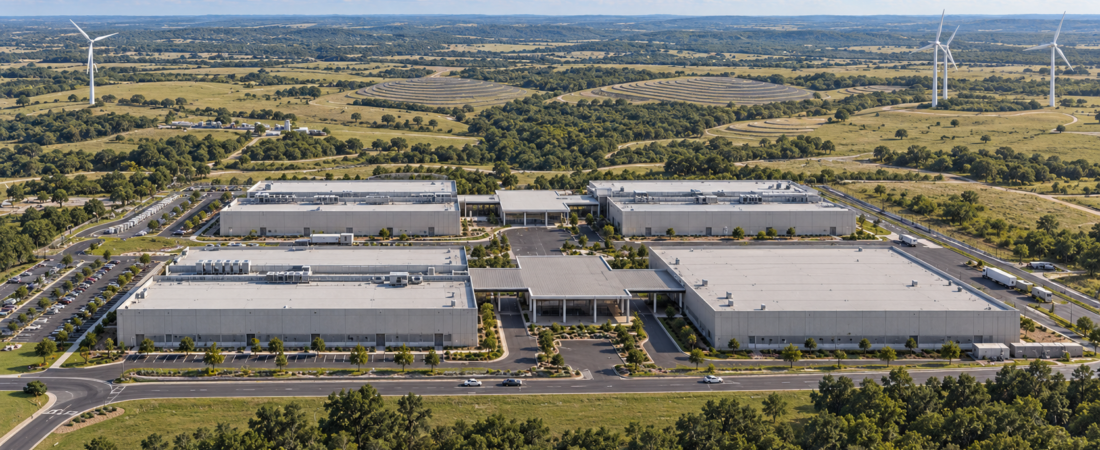
Project Hyper puts a $2.4 billion construction estimate on a proposed data center building in Childress. A Texas accessibility registration lists an 806,359-square-foot facility at 525 A County Road 23, with a scheduled construction window of July 6, 2026, through February 28, 2028. The single-story project includes office space, data center areas and support spaces.
That is roughly 18.5 acres of building area. Yet the most interesting detail may be the name attached to the owner’s contact: a real estate executive at Crusoe, the company behind a newly announced AI campus in Childress.
Project Hyper points toward Crusoe
The filing identifies Childress DC1, LLC as owner and Nader Pakfar as its contact. Crusoe announced Pakfar’s appointment as General Counsel for Real Estate in January 2026. His role covers the company’s global real estate legal strategy and expanding data center portfolio.
That provides a strong connection between Project Hyper and Crusoe. However, the company’s public Childress announcement does not use the Project Hyper name or identify this particular building. HKS is listed as the architect in the registration.
A new chapter after Abilene
Crusoe and Lancium announced a 270-acre, 1-gigawatt Childress campus on July 15. Their joint announcement describes a partnership in which Lancium handles land and energy infrastructure while Crusoe designs, builds and operates the data center.
The companies previously teamed up in Abilene. Childress extends that relationship to another Texas community. They expect thousands of construction jobs and more than 100 permanent positions across the campus, and have pledged support for local infrastructure, housing, education and emergency services.
Those projections concern the wider development. The $2.4 billion figure in the state filing is the estimate attached to Childress Building 1; it should not be treated as a confirmed total for the entire campus.

Power and cooling take center stage
Lancium says its Childress campus has a 1-gigawatt grid interconnection approved by ERCOT. Its plans emphasize closed-loop cooling, which recirculates water, rather than relying on continuous evaporation for cooling.
The distinction matters when explaining a large industrial project to nearby residents. Cooling is one part of the water picture, so the proposed system should not be read as proof that the entire development will have no water needs. Lancium presents water efficiency and power management as central parts of its approach.
What Project Hyper adds to the picture
For readers following Childress development, the filing supplies a building size, an estimated investment and an architect. It adds a more specific construction proposal to the broader campus announcement.
The customer remains unnamed in the announcement. The companies describe a major technology customer, but do not identify it. Likewise, the registration’s scheduled dates do not independently establish that work began in July or guarantee a February 2028 opening.
The opportunity for Childress reaches beyond a large building: the companies’ plans encompass construction employment, ongoing operations and community investment. Project Hyper gives residents another concrete piece of that unfolding development to follow.