
One of Dallas’ largest hospitals is preparing for a major investment in cancer care.
Medical City Dallas Hospital has registered a $108.7 million renovation project at its longtime campus at 7777 Forest Lane, according to a newly filed Texas Department of Licensing and Regulation project. The work is expected to cover approximately 100,420 square feet across Buildings A and E.
But this isn’t simply another hospital renovation.
The project is specifically designed to expand cancer hospital bed capacity and the hospital’s stem cell laboratory, two areas tied to some of the most specialized cancer treatment offered at Medical City Dallas.
Construction is currently scheduled to begin in February 2027 and continue through February 2030.
A Major Investment in Cancer Care
Medical City Dallas already operates one of the region’s notable blood and marrow transplant programs.
The hospital says it is the only hospital in North Texas offering both adult and pediatric stem cell transplants. Its program treats patients with blood cancers and disorders including leukemia, lymphoma and multiple myeloma.
The program’s history stretches back more than three decades. Sarah Cannon Cancer Network says Medical City’s Stem Cell Transplantation and Research Program was founded in 1994 and performs both adult and pediatric stem cell transplants.
And the volume involved is substantial.
National Marrow Donor Program data shows Medical City Dallas recorded 635 transplants by cell source during 2023 and 2024, including 396 autologous procedures and 233 using peripheral blood stem cells from another source. The center performs both adult and pediatric transplants.
That gives considerably more context to a construction filing that simply says the hospital plans to expand its stem cell lab.
Medical City Has Made This Kind of Investment Before
There’s also some history repeating itself at 7777 Forest Lane.
In 2013, Medical City Dallas announced another massive expansion—then valued at approximately $114 million—in response to growing demand for oncology, emergency and transplant services.
That project added 100 hospital beds and 18 stem cell patient rooms, while nearly 40 private oncology rooms were slated for renovation. Four additional floors were also planned for Tower E.
More than a decade later, Medical City is again preparing an investment exceeding $100 million that specifically targets cancer capacity and stem cell treatment infrastructure.
The two projects have not been publicly identified as connected phases, but the similarities show just how long cancer and transplant services have played a role in the campus’ growth.
From One Building to a 2-Million-Square-Foot Medical Campus
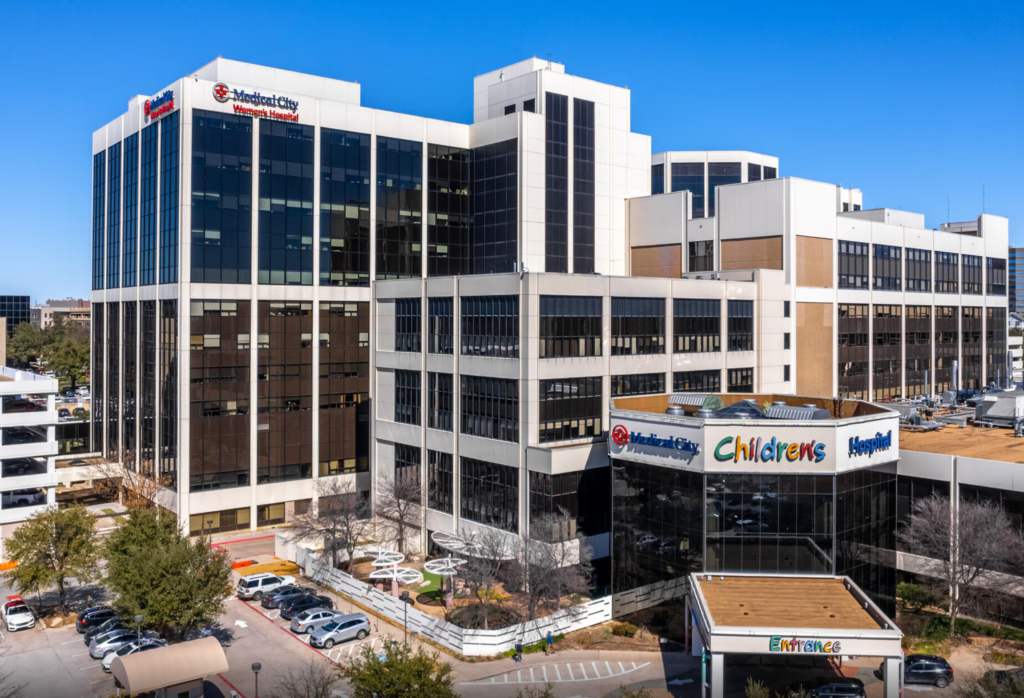
Medical City Dallas itself has changed dramatically since opening in 1974.
The campus began with a single approximately 400,000-square-foot building. Medical City’s property management organization says the campus has expanded roughly every five years since then and has grown to seven buildings totaling about 2 million square feet.
Today, Medical City Dallas operates as an 899-bed acute-care hospital with a medical staff of more than 1,500 providers.
Building A, one of the two structures included in the upcoming cancer project, is actually part of the hospital’s original development.
Building E came much later. It was completed as a six-story building in 2006 before another six floors were added in 2014. Now known as the Critical Care Tower, it houses the emergency department and multiple critical-care departments.
Those are the same two buildings identified in the new $108.7 million cancer renovation.
Three Years of Construction Ahead
According to the new state filing, the Medical City Dallas cancer project is expected to begin Feb. 1, 2027, with completion currently scheduled for Feb. 1, 2030.
The filing describes the project as an interior renovation rather than construction of a separate cancer hospital. It does not specify how many additional cancer beds will be created or provide details about the planned expansion of the stem cell laboratory.
Those details could emerge as the project moves closer to construction.
What is already clear, however, is the scale.
More than 100,000 square feet of hospital space. Nearly $109 million in estimated investment. Expanded cancer bed capacity. An expanded stem cell laboratory. And approximately three years of construction inside a medical campus that has been growing for more than half a century.
For Medical City Dallas, the next major expansion isn’t about adding another building to the skyline.
It’s about creating more room inside the buildings it already has to treat patients facing some of the most serious illnesses.