
Concrete Reinforcements Inc., or CRI, plans a $7 million production expansion in south Houston, adding a 22,000-square-foot building at 12320 Kirby Drive. The project pairs manufacturing space with offices for a business whose products largely disappear from view once construction is complete.
The company makes structural welded-wire reinforcement: engineered steel grids that become embedded inside concrete. Instead of assembling every reinforcing intersection at a jobsite, manufacturers weld the wire into specified configurations before shipping it to a contractor or concrete producer.
That makes the Houston South Building more than another addition to the city’s industrial inventory. It would expand production of a component that illustrates a broader construction strategy: moving repetitive assembly into a factory while leaving crews to handle placement and the other work that must happen in the field.
CRI plans expanded production on Kirby Drive
The new state registration, TABS2027001709, describes a building using tilt-up panels and concrete masonry units for “expanded production and offices.” Concrete Reinforcements Inc. is the owner, and Method Architecture is the design firm.
That stated use gives the project a defined manufacturing purpose. The filing describes additional space for production rather than an industrial shell awaiting a future tenant. It does not quantify the increase in output or identify the machinery the new building will house.
The registered construction schedule runs from Feb. 2 through Oct. 2, 2027. Those are projected construction dates, not an announced opening or production-start date.
What CRI makes before the concrete arrives
On many concrete projects, crews position individual reinforcing bars and tie them together to form the required arrangement. Structural welded-wire reinforcement, commonly shortened to WWR, shifts part of that assembly upstream.
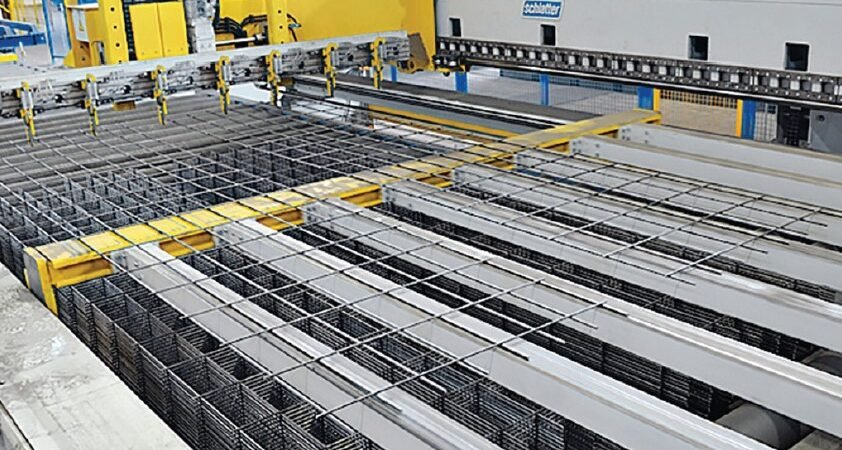
Its intersecting wires form an engineered grid. Resistance welding joins the intersections during manufacturing, establishing the specified spacing before the material reaches the project. The result is reinforcement that arrives with part of its assembly already complete.
The word “wire” can make the product sound lighter-duty than its role suggests. Structural WWR belongs to the reinforcing system within concrete, with its configuration selected for the application. CRI markets it as an alternative to labor-intensive hand-tied reinforcing steel.
That is an option for appropriate designs, rather than a universal replacement for conventional rebar. The useful distinction is where part of the work occurs: a manufacturing line establishes the grid before workers place it into the concrete assembly.
Reinforcement hidden inside everyday construction
CRI’s product applications span both precast concrete and concrete cast at the jobsite. The company identifies uses in box culverts, precast bridges, vaults and manholes, along with slabs-on-grade, tilt walls, pilasters and barriers. Its application list also includes bridges, channels, post-tension beams and walls.
These are components of buildings, drainage systems and transportation infrastructure. A person might cross a bridge, pass a concrete barrier or enter a building without ever seeing the reinforcing grid within it. Concrete placement conceals the steel that helps the finished element do its job.
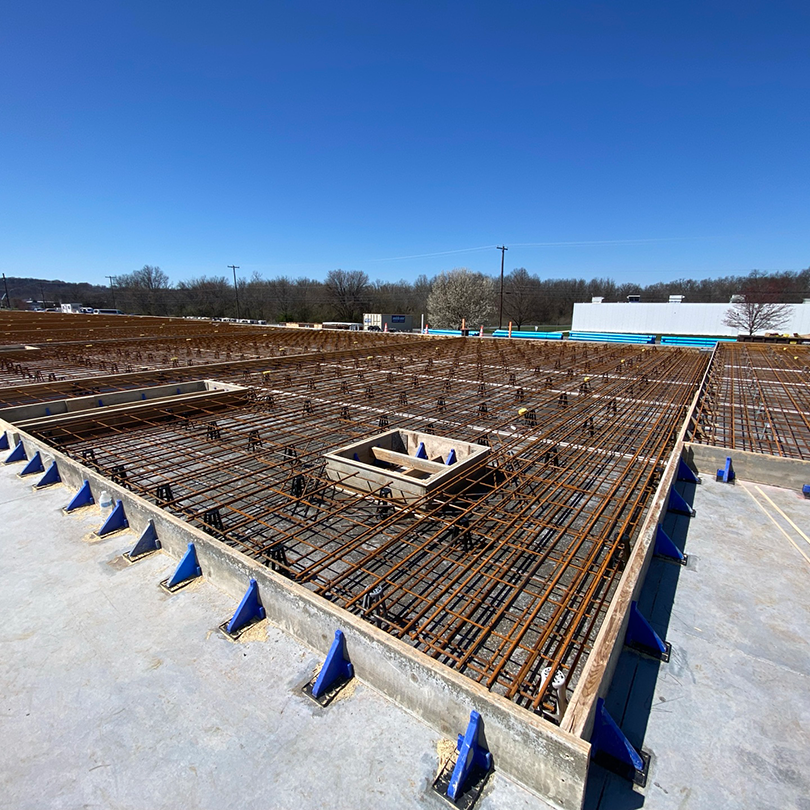
The range also shows why offsite manufacturing does not mean the entire finished structure comes from a factory. A welded grid can go to a precast plant that makes concrete components, or to a jobsite where crews cast concrete in place. In either case, some reinforcing assembly happens earlier in the supply chain.
Why CRI’s factory model matters to field crews
Reinforcing work requires accurate positioning before a pour. Repeating that task across a large slab, wall or series of concrete components can involve substantial field labor. Factory-made grids transfer some of those repeated connections into a controlled production process.
In its standard WWR specifications, CRI says welding maintains precise spacing and helps reinforcement remain in the position intended by the design during concrete placement. The company states that its standard product complies with ASTM A1064, the specification covering steel wire and welded-wire reinforcement for concrete.
Independent research supports the broader assembly principle. A 2019 study in Construction and Building Materials examined reinforced-concrete beams using prefabricated welded reinforcement grids. The researchers described how accurately fabricated grids could simplify cage assembly and reduce labor and construction time.
That study addressed a particular reinforcement system, not CRI’s Houston expansion or every WWR application. It supports the potential of prefabrication without establishing a universal savings figure. A project’s design and installation requirements still determine whether a manufactured grid is a suitable choice.
The broader implication is a change in the division of work. Manufacturing can take on some repeated assembly, while field crews still position and support the reinforcement, coordinate it with other components and prepare for concrete placement. Factory production does not eliminate those responsibilities.
CRI builds on an existing Houston footprint
CRI dates to 1996, according to its company profile. Its current manufacturing directory lists operations in Houston; Surprise, Arizona; and Jacksonville, Florida. The Kirby Drive project therefore adds to an established manufacturing business with a presence in three states.
Houston has already figured in that investment history. Historical project reporting described an approximately 84,192-square-foot, $8.98 million CRI development at 12500 Edwina Boulevard, with planned occupancy in 2021. That earlier proposal provides context for the company’s continuing investment in Houston manufacturing.
The available records do not establish that the Edwina Boulevard project and the new Kirby Drive building form one continuous facility. Nor do they establish a relocation or consolidation of the company’s Houston operations.
CRI’s current website lists its Texas plant at 3030 Mowery Road, while other company material has used 12350 Amelia Drive. The new registration uses 12320 Kirby Drive. Those different addresses do not, by themselves, show that another plant will close or that the entire Houston operation is moving.
An established public-infrastructure supplier
CRI’s Houston operation also appears in TxDOT’s September 2026 reinforcing-steel producer list. The agency lists the Houston plant among approved wire and welded-wire reinforcement mills. The same document also identifies the company’s Jacksonville and Surprise locations.
The listing places CRI within the approved supply base for public infrastructure materials. It is a qualification for supplying the relevant products, not evidence that the planned Kirby Drive building has secured orders for a particular highway, bridge or drainage project.
That connection helps explain the manufacturing expansion’s wider relevance. Reinforcement production supports contractors and concrete producers working on assets far beyond the factory’s property line. The finished steel may be invisible to the public, but its fabrication remains part of the construction process.
What comes next for CRI in south Houston
For Kirby Drive, the defined next chapter is additional production and office space. The state filing establishes the building’s intended use, scale, design firm and estimated construction window. It does not yet establish how much additional reinforcement CRI will manufacture there or when the first shipment will leave.
A relatively anonymous industrial building could ultimately produce steel most people will never see after a project is finished. Inside concrete walls, slabs and infrastructure, those grids would be out of sight. How they get there reflects a practical shift in construction: completing more repetitive assembly in a controlled factory before the work reaches the field.
Featured image: Representative welded-wire reinforcement manufacturing equipment. The image illustrates factory production and does not depict the planned Kirby Drive building.