
Before banking fit in your pocket, it pulled up beside a teller window. The Frost motor bank planned for replacement on South Alameda Street gives Corpus Christi a fresh connection to that long-running American convenience: handling an errand without leaving the driver’s seat.
Frost plans to demolish its existing motor-bank building at 3835 S. Alameda Street and construct a larger replacement, according to a state registration. The privately funded project lists $2 million in estimated construction costs and 1,095 square feet, with work scheduled from October 5, 2026, through May 5, 2027.
A New Chapter for the Frost Motor Bank
The address is home to The Village Financial Center, an existing Frost location in Corpus Christi. Its listed services include a motor bank, walk-up ATM, and night deposits alongside lobby banking.
The project specifically covers the motor-bank structure. Registration TABS2027000593 describes complete removal of that building, site preparation, and construction of the new facility. It does not describe demolition of the entire financial center or specify the replacement’s lane count.
That distinction will matter when work begins: the plan is to rebuild an established drive-through banking facility. The listed completion date is a construction estimate, and the filing does not provide a customer reopening date or temporary service arrangements.
When Banking Followed America Into the Car
Motor banks emerged in the 1930s, according to Wells Fargo’s corporate history. Their rise followed a familiar pattern: more automobiles, growing suburbs, and customers eager to combine errands into one trip.
Between 1945 and 1955, the number of cars in the United States doubled to roughly 50 million. Banks responded with drive-up windows. By 1964, a Denver bank had opened a 15-lane motor bank—an operation closer in scale to a busy toll plaza than a single teller window.
Customers needed practice, too. When an Iowa bank opened its motor bank in 1959, some drivers entered the wrong way. One mistook the teller for a parking attendant and offered a dollar. Even the most ordinary errands have a learning curve when the format is new.
The Frost Motor Bank Story Goes Back to 1965
Frost began in 1868 in a San Antonio mercantile store. Its official history timeline dates the opening of its first motor bank to 1965. The accompanying photograph captures the moment beautifully: a Volkswagen Beetle at the window, another car behind it, and a teller serving the driver beneath a broad covered structure.
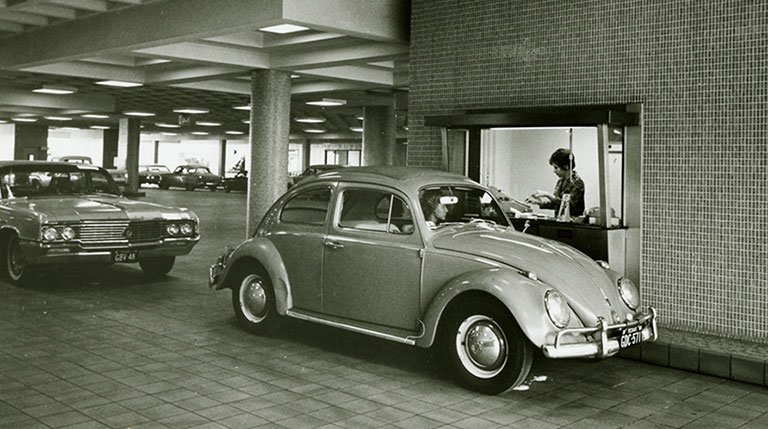
That Beetle makes a useful time marker. Frost’s timeline later records ATMs in 1979, online banking in 2000, and its smartphone app in 2013. Each step brought another way to reach the bank, from rolling down a window to tapping a screen.
The Little Tube That Made Banking Feel Futuristic
Then there is the part many passengers remember best: the capsule that disappeared into a tube and came back with the paperwork.
The mechanism is a pneumatic tube system. As manufacturer Aerocom explains, blowers create differences in air pressure that move carriers between stations. Cash, checks, and documents can travel between a customer and teller without either person walking across the drive-through lanes.
The same basic idea extends well beyond banking. Hospitals use tube systems to move samples, medications, and documents around their buildings. What feels like a nostalgic bank errand is also a practical method of transporting physical objects.
The Corpus Christi filing does not identify the new motor bank’s equipment. Its connection to this history is the service itself: a place designed for banking from a vehicle.
Why the Frost Motor Bank Still Makes a Local Story
An app can move information instantly. Physical cash and face-to-face service still call for different arrangements. The Village’s existing mix of lobby, ATM, and motor-bank services shows those options operating side by side.
On Alameda, the next chapter is a replacement building for that familiar errand. The cars have changed considerably since the Beetle in Frost’s old photograph. The appeal of getting something done without climbing out of one is easy to recognize.