

NetJets already serves Austin. A newly registered $19.5 million Signature Aviation project now outlines a deeper investment in that presence: a dedicated terminal accompanied by an aircraft ramp more than 13 times the size of the enclosed building.
The proposed development at 2500 E. State Highway 71 includes an approximately 8,000-square-foot terminal, 106,000 square feet of airside ramp and a parking lot. Its significance extends beyond passenger amenities. The project would add working ground infrastructure beneath a fractional-aviation network expanding both its fleet and its activity.
Austin supplies a timely setting for that investment. General-aviation operations at Austin-Bergstrom International Airport have turned upward in 2026 after a nearly flat 2025. Recurring major events create intense traffic peaks, while the region’s corporate and advanced-manufacturing economy provides a broader backdrop for business travel.
NetJets is deepening an existing Austin presence
The company’s current locations information already lists Austin among markets with private-terminal access and NetJets Service Representatives. Those employees assist with arrivals and departures at more than 30 of its frequently used private terminals worldwide.
That service presence is distinct from a dedicated new facility. The locations page separates exclusive-use terminals from other terminals with company representatives; Austin appears in the latter group. The new state registration should therefore be understood as infrastructure expansion in an established market.
The Signature Aviation Terminal Project for NetJets, TABS2027001729, identifies Signature Flight Support LLC as owner, NetJets as tenant and HDg Architecture as design firm. Projected construction runs from Jan. 26, 2027, through June 22, 2028. These are state-registration estimates, not an announced opening date.
The NetJets ramp is the larger physical investment in space
The proposed terminal is relatively compact. Its 106,000-square-foot ramp covers 13.25 times the terminal’s approximately 8,000 square feet, underscoring how much of a private-aviation facility’s function happens outside the passenger building.
A ramp is the aircraft-side operating area. It provides room for aircraft positioning, staging, ground support and passenger transfers. Those functions help connect a traveler arriving by car with an aircraft preparing to depart, and help crews manage the next movement after an arrival.
Square footage alone does not establish how many aircraft the Austin ramp could accommodate. Aircraft dimensions, required clearances and operating arrangements all affect capacity. The filing also does not identify hangars, maintenance facilities or a NetJets Service Hub.
The useful distinction is between the visible passenger terminal and the operating space around it. Adding a lounge without adequate aircraft-side infrastructure would address only part of what a busy aviation network needs.
NetJets expands in the air and on the ground
NetJets says its network handles more than 1,400 flights worldwide each day and approximately one in six U.S. business-jet departures. The company also expects more than 80 factory-new aircraft deliveries during 2026.

Fleet additions bring an accompanying ground-infrastructure challenge. Aircraft need places to stage, receive support and load passengers before returning to service. As a network grows, terminal access and aircraft handling become part of the capacity equation alongside the number of jets available.
NetJets says it is expanding its exclusive-use private-terminal network at popular airports. The Austin registration fits that broader direction, supplying a defined local scope for additional ground facilities. It does not establish every operating detail of the eventual terminal.
Fractional aviation gains activity as other models soften
Fractional aviation gives customers access to a managed aircraft fleet, commonly through a share or lease, without requiring them to own and operate an entire aircraft independently. Providers organize aircraft, crews and scheduling across many customers and trips.
That model is gaining activity unevenly within the wider business-aviation market. JETNET’s August 2026 JIQ Market Barometer, using data through July, reported fractional activity up 10.7% on a trailing-12-month basis. Corporate flight-department activity fell 7.1%, while branded charter slipped 0.6% over the same period.
The report put NetJets’ trailing-year activity growth at 10.4% and its share of global business-jet activity in the dataset at 13.3%. The analysis excludes turboprops and draws on JETNET, WINGX and flight-tracking sources.
Those results describe a shift among operating models, rather than a uniform surge across all private aviation. They also help explain the infrastructure question: operators gaining a larger volume of flying need ground facilities that can support frequent aircraft movements.
Austin aviation turns upward in 2026
Local airport figures show renewed growth, with an important limit on what they measure. AUS reported 25,246 general-aviation operations from January through July 2026, up 6.48% from the same period a year earlier. July alone was up about 4.56%.
That followed 42,683 general-aviation operations in 2025, which the airport’s year-end release described as down 0.43%. The trajectory is renewed growth after a broadly flat year, rather than uninterrupted expansion.
General aviation is a wider category than NetJets or fractional flying. The airport totals provide local activity context; they do not measure NetJets’ Austin market share or identify the customers using its service.
Major events test Austin’s ground capacity
Signature’s 2026 Formula 1 aviation guidance describes an influx of private aircraft, corporate flight departments, fractional operators and VIP travelers for the U.S. Grand Prix. It expects AUS and Austin Executive Airport to be the busiest private-aviation airports during the race weekend.
The company says its existing AUS operation can handle up to approximately 70 private aircraft during that event, including remote parking. That is a statement about Signature’s existing race-weekend arrangements, not a capacity estimate for the proposed NetJets ramp.
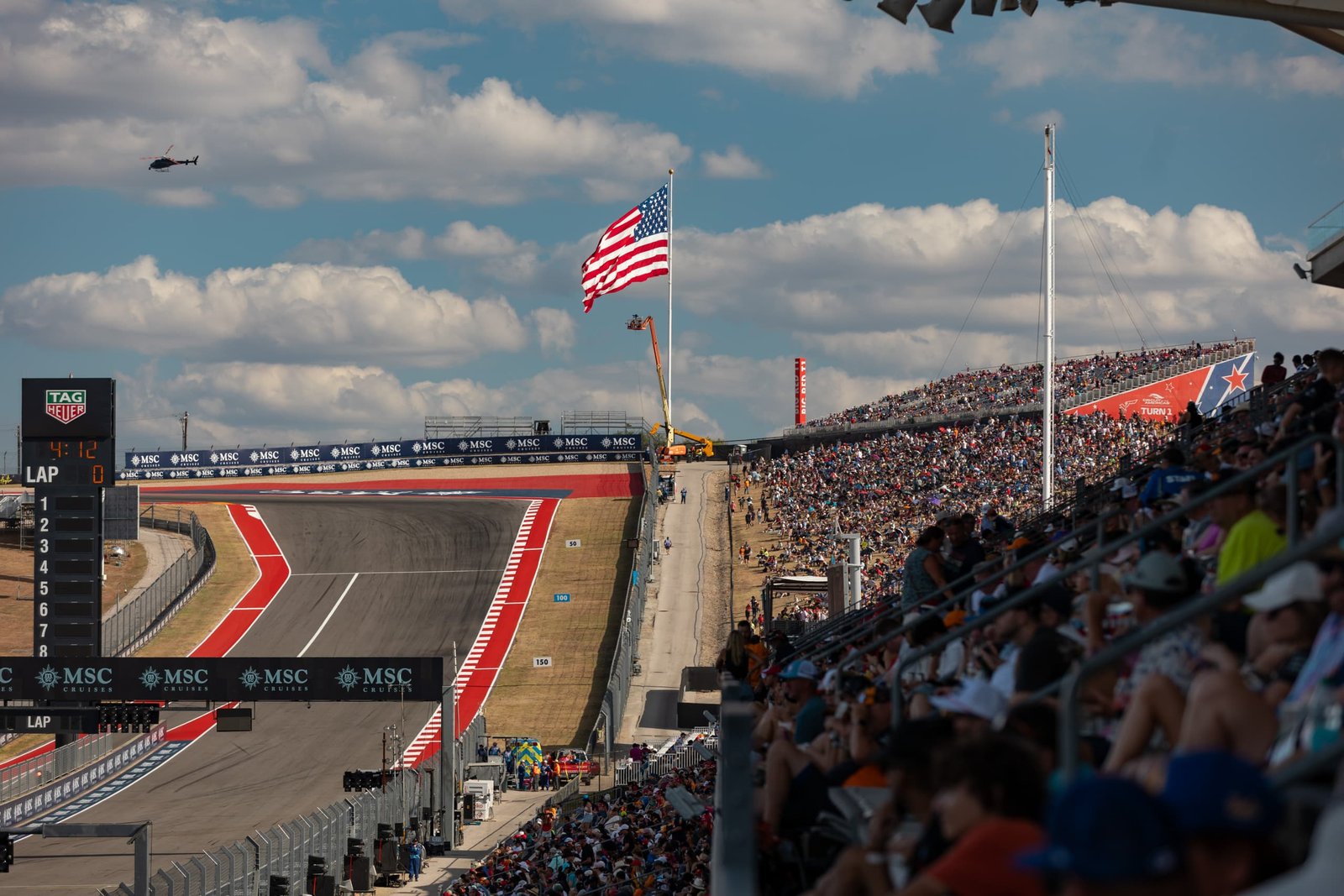
F1 illustrates why ground space matters during concentrated arrival and departure periods. Aircraft parking, staging and passenger transfers must work together when many travelers want to reach the same event at roughly the same time. There is no evidence establishing that the new terminal is being built specifically for the race.
Austin’s calendar includes other recurring travel draws: SXSW, Austin City Limits Music Festival, major University of Texas football weekends and MotoGP at Circuit of the Americas. These events differ in audience and scale, but collectively create repeated periods of heightened travel demand rather than a single annual peak.
A corporate economy beyond event weekends
Year-round business activity provides another part of the regional context. Tesla’s Gigafactory Texas spans approximately 2,500 acres and more than 10 million square feet of factory floor. Its Austin headquarters and manufacturing operations are part of the region’s growing industrial base.
Samsung says its Austin and Taylor campuses generated an estimated $10.9 billion in Central Texas economic activity in 2025. The company has outlined regional investment plans exceeding $37 billion.
Apple, meanwhile, reported in an August 2025 campus update that three completed Austin office buildings exceeded 1 million square feet, with construction continuing on its second campus.
These investments describe the economy surrounding the airport. They do not establish that Tesla, Samsung, Apple or their executives are NetJets customers, or that any of those companies caused this project. The defensible connection is geographic and economic: aviation infrastructure is expanding in a region with major headquarters, engineering and manufacturing investment.
Signature brings a long Austin history
Signature already operates one of AUS’s three fixed-base operations, alongside Atlantic Aviation and Million Air. A fixed-base operator, or FBO, supplies ground services for private and general aviation. Signature’s existing operation is at 4321 Emma Browning Avenue.
Its city relationship stretches back roughly a quarter-century. Austin council records trace an agreement to manage 54 city-owned general-aviation hangars to December 2001. Subsequent extensions continued that relationship, including another authorization in 2026.
Signature therefore brings an established local operating history to the new project. Its role extends beyond developing a passenger building to the ongoing work of supporting aircraft and aviation customers at AUS.
A NetJets partnership with a Las Vegas precedent
The companies have already demonstrated their infrastructure partnership elsewhere. In October 2024, they announced a groundbreaking at Harry Reid International Airport in Las Vegas, describing it as their first new-build collaboration.
That separate campus includes a larger terminal and maintenance development with hangars. It emphasizes dedicated passenger handling and efficient movement between ground transportation and aircraft. The featured rendering accompanying this article depicts that Las Vegas development.
Austin’s registration establishes a narrower scope: a terminal, ramp and parking. The Las Vegas precedent demonstrates an existing partnership, but it does not justify assigning hangars, maintenance functions or the same campus model to Austin.
What the new Austin terminal would add
The state registration puts physical dimensions and an estimated construction timetable around NetJets’ next Austin infrastructure chapter. Its defining feature is the combination of a relatively small passenger building with a much larger working aircraft area.
That balance reflects the practical demands beneath fractional aviation’s growth. More flying requires places to prepare aircraft, coordinate crews and move passengers efficiently. In Austin, those needs sit alongside renewed general-aviation activity, substantial business investment and recurring event peaks.
The $19.5 million project is one piece of that larger network. Its importance lies in the operating capacity it could add to an established aviation market, with the opening schedule and final operating arrangements still to come.
Featured rendering: The separate NetJets and Signature Aviation development in Las Vegas—not the planned Austin terminal. Source: NetJets and Signature Aviation project announcement.