
Princeton Town Center is building a deeper construction pipeline along U.S. 380. Newly registered Kroger, Hobby Lobby and PetSmart projects join earlier filings for Home Depot, TJ Maxx, HomeGoods, First Watch and several retail buildings, giving more of the long-planned development a defined construction scope.
For a city that grew from roughly 17,000 residents in 2020 to more than 43,000 in 2025, the significance reaches beyond any one store. Major shopping anchors and the smaller spaces around them are moving through the same development pipeline, bringing the commercial side of Princeton’s growth into sharper focus.
A Texas Construction Media review identifies more than $52 million in filed construction value across the projects. The ground-up building and garden-center scopes alone cover more than 435,000 square feet. Tenant interiors are tracked separately to avoid counting space twice within larger shells. These are registered construction estimates, not the development’s total investment.
Three new projects widen the Princeton Town Center pipeline
The newest registrations cover three different pieces of the shopping center: a full grocery anchor, a large arts-and-crafts store and an interior build-out for a pet retailer. Each has a specific address and scope, a more concrete milestone than a name appearing on a leasing plan.
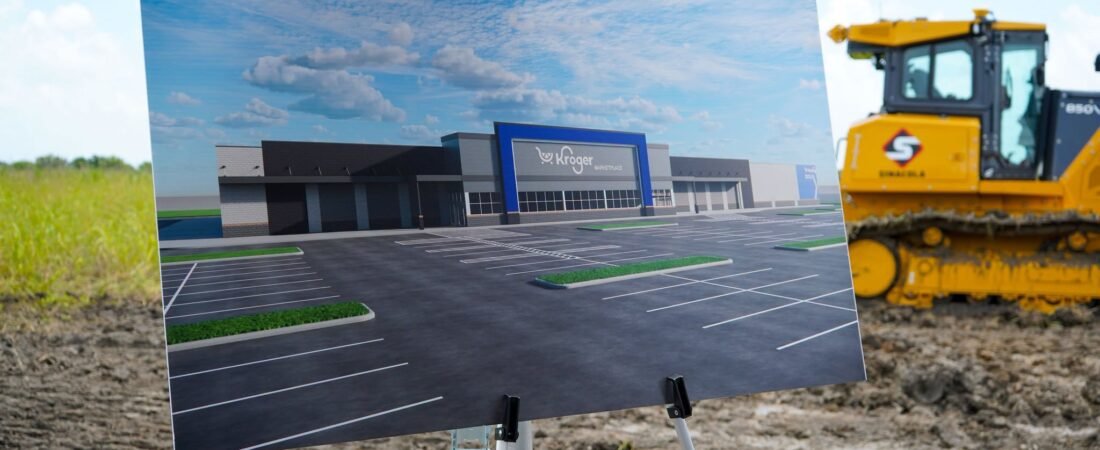
Kroger Marketplace is registered at 1120 W. Princeton Drive as a 99,992-square-foot food store with associated site improvements. The state filing, TABS2027001835, lists $10.7 million in estimated construction work and a projected Jan. 28–Oct. 8, 2027, schedule.
That filing follows Kroger’s July groundbreaking. It does not mean work at the property will begin for the first time next January, and its construction estimate should not be confused with the grocer’s broader investment.
In its groundbreaking announcement, the City of Princeton described Kroger’s commitment as nearly $40 million, with approximately 200 jobs expected. The Marketplace is planned to combine groceries, a pharmacy and expanded general merchandise with specialty offerings such as Murray’s Cheese. A fuel center would include 14 fueling positions and a grab-and-go kiosk.
Hobby Lobby is registered at 1170 W. Princeton Drive for 55,000 square feet of new construction. Its filing, TABS2027001847, carries a $5.28 million construction estimate and a projected Nov. 1, 2026–Aug. 1, 2027, work schedule.
PetSmart is a different kind of project: a 16,353-square-foot tenant improvement inside a shell building at 1270 W. Princeton Drive. Registration TABS2027001731 lists $1 million in work and projected construction from March 29 through Dec. 19, 2027.
All of those state-filed schedules are construction estimates. They are not announced store opening dates, and the registrations do not establish that every listed project is already under construction.
Princeton Town Center extends beyond the anchors
Home Depot already has a registered ground-up project encompassing a 107,828-square-foot store and a 28,156-square-foot garden center. Together, those spaces total about 135,984 square feet, with a filed construction estimate of $13 million.
The pipeline also includes TJ Maxx and HomeGoods. Their individual tenant upfits cover 25,278 and 24,231 square feet, respectively, with construction estimates of about $2.02 million and $1.94 million. Both filings project work from February through October 2027.
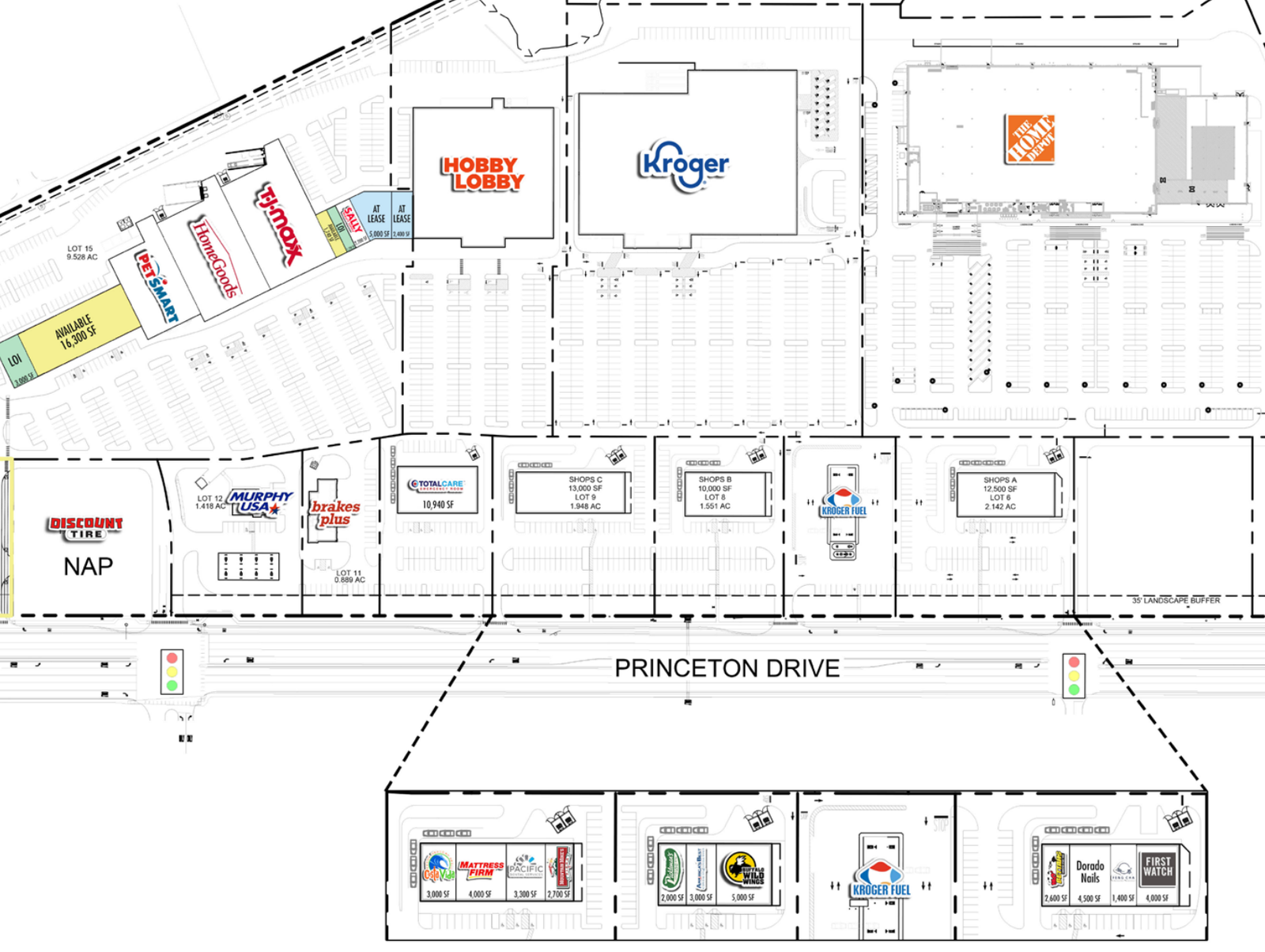
Those interiors are associated with the larger Lot 15 retail shell. The shell registration describes 97,704 square feet of new tilt-wall construction with capacity for multiple tenants and an estimated value of about $11.74 million. The leasing plan also places PetSmart in that retail grouping, another reason to keep shell area and tenant work distinct.
Four other ground-up buildings, identified as Shops A through D, add approximately 46,814 square feet. Their individual sizes range from about 10,300 to 12,900 square feet, and their combined filed construction value is approximately $5.62 million. They share an ownership and design team and a projected November 2026–July 2027 construction window.
That combination matters. The anchors establish the development’s biggest shopping destinations, while multi-tenant buildings provide space for additional retailers, restaurants and services. A shell registration establishes the building project; it does not confirm which business will occupy every suite.
Among the individual restaurant projects, First Watch has a registered 4,000-square-foot build-out with a $900,000 construction estimate. Its projected January–May 2028 schedule also shows why the center should be understood as a development with several work programs, rather than a single project with one opening day.
Years of planning come into view
The current filings follow years of planning, evolving tenant concepts, development agreements and infrastructure coordination. A preliminary plat won approval in 2024, but site and easement issues helped stretch the development process.
Local reporting on the July planning proceedings described the shifting easements and the distinction between groundwork and vertical construction. That distinction remains useful: grading, utilities, plats, building construction and tenant interiors are separate steps toward an operating shopping center.
By summer 2026, earlier retail registrations were in place, Kroger held its July 15 groundbreaking, and the city reported grading and dirt work underway. In September, the final plat for roughly 66.6 acres reached another late-stage land-development milestone in city planning proceedings.
The new registrations therefore widen an existing pipeline. They give additional parts of the development defined scopes, budgets and estimated work windows after a long period when residents mainly had plans and announcements to follow.
Princeton’s rooftops arrived faster than the retail
For years, the rooftops arrived faster than the retail.
The Census Bureau’s latest estimates put Princeton at 43,524 residents in 2025, compared with about 17,000 around the 2020 Census. That growth has changed the scale of the community that stores, restaurants and everyday services need to serve.
For residents, a development of this size could put more errands within the city: groceries, home improvement supplies, pet products and household shopping, alongside restaurant and service space. The filings do not show when every option will become available, but they establish a much broader construction pipeline than an isolated store announcement.

Princeton’s 2019 Comprehensive Plan identified U.S. 380, also known as Princeton Drive, as its principal commercial and transportation corridor and called for larger community-serving commercial development along it. Town Center’s scale and location fit that long-standing objective.
The question now is how the individual projects move through construction and become usable shopping space. Registrations are meaningful evidence of that progression, but residents will experience the change store by store as the development takes shape.
What Princeton Town Center could mean for city revenue
The city’s development overview projects more than $3 million in annual sales-tax revenue at buildout for the approximately 66-acre center. That is a forecast of the completed development’s contribution, not revenue the city is already collecting from these projects.
For context, Princeton’s adopted fiscal 2025–26 budget projected $4.55 million for the city’s one-cent sales-tax share. Its financial reporting separately accounts for the economic and community development corporations’ shares.
The forecasts should not be treated as directly interchangeable or used to calculate a simple percentage increase. They do show why a large retail development matters to a fast-growing city: shopping activity can broaden the municipal revenue base as more residents require public services.
Similarly, the construction-registration total measures a particular set of work scopes. It is not a full accounting of land, equipment, inventory, financing or every other development expense. Kroger’s nearly $40 million overall investment is separate from its $10.7 million construction filing and has not been added on top of that filing in TCM’s construction-value total.
The next chapter along U.S. 380
The current leasing materials identify additional planned or announced tenants across the property. Those businesses may be at different stages, and a logo on the plan should not be read as proof that a tenant has registered construction.
The documented pipeline is substantial on its own: grocery and home improvement anchors, arts-and-crafts and pet retail, off-price and home retailers, a restaurant build-out and multiple retail shells. The latest registrations add specificity to that picture without requiring every planned tenant to be at the same stage.
For much of Princeton’s recent growth cycle, subdivisions supplied the most visible evidence of change. Now a growing collection of Princeton Town Center projects shows the commercial side beginning to catch up. From large anchors to smaller shops and tenant interiors, more of the development has moved beyond a name on a plan and into an identifiable construction program.
Featured image: A Kroger Marketplace rendering displayed at the Princeton project site, with construction equipment behind it. The photograph shows the planned store design at the site, not a completed store.