
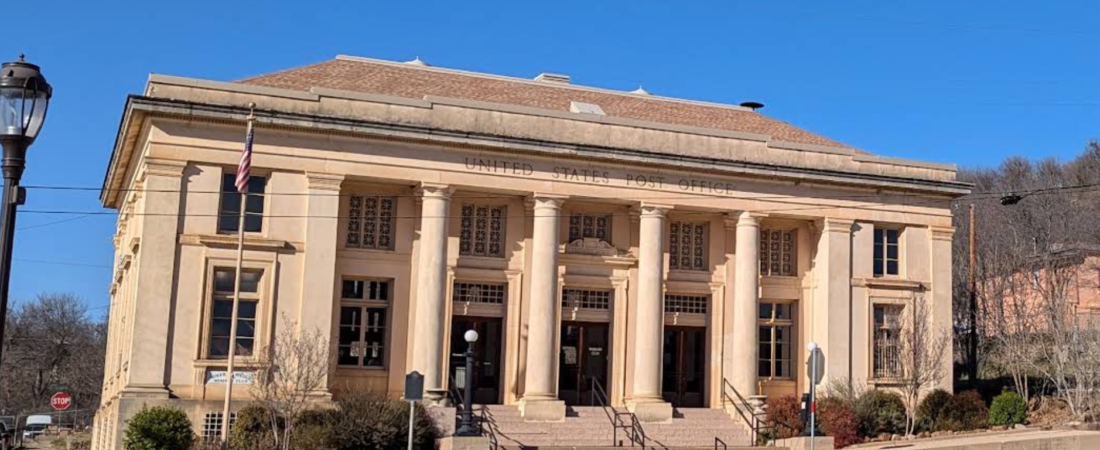
Mineral Wells has learned the hard way that a city can lose pieces of itself one building at a time. That is why the next chapter for its century-old former post office feels bigger than a renovation. It is another chance to keep the architecture that tells people exactly where they are — and where this town has been.
The historic post office on Northeast 2nd Street in Mineral Wells is headed for a major restoration. The work will repair masonry and stucco, restore wood doors and windows, replace the roof, stabilize and waterproof the foundation and bring back the front stairs. In other words, this is not about stripping the building of its character. It is about helping that character survive another century.
Built when Mineral Wells was becoming a destination
To understand why the building matters, go back to the beginning of the Mineral Wells story. James Alvis Lynch settled here in 1877, and after a well was drilled on his property, stories spread that the mineral-rich water made people feel better. Visitors began arriving for the water, and a health-resort town grew around them.
By the early 1900s, Mineral Wells was booming. A National Register history of downtown says the city had about 5,000 residents by 1904 while hosting more than 85,000 visitors from the United States and Europe. Within a few years, annual visitation had climbed above 150,000. That kind of traffic meant mail, business and communication were growing right along with the hotels and bathhouses.
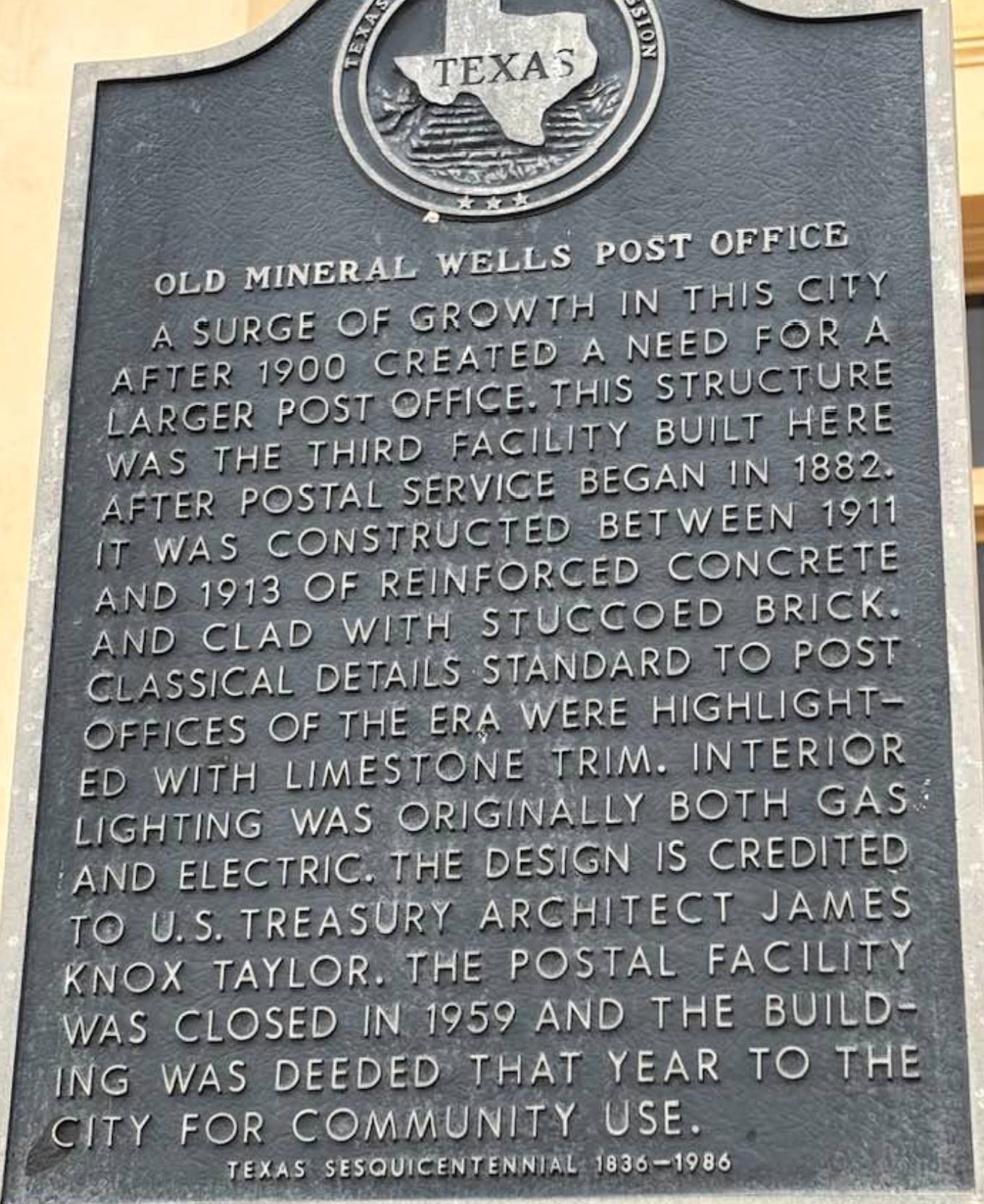
Postal service had begun in Mineral Wells in 1882. The building we know today became the city’s third post office and was constructed between 1911 and 1913. The Texas Historical Commission credits its design to U.S. Treasury architect James Knox Taylor. Reinforced concrete was wrapped in stuccoed brick, while limestone trim and classical details gave the public building a sense of permanence and civic importance.
A building that helped anchor downtown
Mineral Wells did not develop around a traditional courthouse square, which makes buildings like the old post office especially important to the shape and identity of downtown. The National Register documentation for the Mineral Wells Commercial Historic District specifically describes the post office as an anchor for the historic core.
Its original interior even reflected a city living between eras: the building was equipped with both gas and electric lighting. Outside, its classical columns and formal entrance gave a growing resort town the kind of federal building that announced Mineral Wells had arrived.
The post office served the community until 1959. When postal operations ended, the building was deeded to the city for community use and later became home to the Mineral Wells Women’s Club. So even after the mail moved out, the building never stopped being part of civic life.
Mineral Wells is rediscovering the value of what it already has
This restoration lands at an interesting moment for Mineral Wells. The city once became nationally famous because of its mineral water, resort hotels and health culture. By 1920, more than 400 wells had been drilled, and thousands of visitors were arriving each day. The Baker Hotel later became the grand symbol of that era.
Then the story changed. Modern medicine weakened the health-resort business. Interstate 20 redirected through-traffic south of town. Fort Wolters closed in 1973. Mineral Wells lost population and pieces of the economy that had once made it a destination.
Today, the city is leaning back into the things that made it distinctive in the first place: history, architecture, wellness, Crazy Water and the buildings that survived the boom years. The enormous effort to revive the Baker Hotel is the headline-grabber, but preservation works best when it does not stop at one famous landmark.
Why saving an old post office is worth $2.3 million
A historic building cannot tell its story if water reaches the foundation, the roof fails or original windows disappear one replacement at a time. That is why the details of this project matter. Foundation stabilization, waterproofing, masonry repair and wood restoration are not glamorous, but they are the work that keeps a 1910s building standing.
The current restoration carries an estimated $2.3 million construction cost and covers roughly 8,500 square feet. State records list the project at 215 NE 2nd Street, while the Texas Historical Commission’s marker record uses 201 NE 2nd Street; both identify the old post office at the same historic corner. The preservation-focused Dallas firm Architexas is listed as the designer.
For Mineral Wells, the payoff is not simply a repaired building. It is continuity. Visitors can drink the water, watch the Baker rise again and walk through a downtown where the architecture still explains how this unlikely health-resort town in Palo Pinto County once became known far beyond Texas.
New construction can show where a city is going. Sometimes, though, the most valuable project is the one that makes sure a city remembers where it came from.