
For a family working and studying online, or a small business sending large files, a new internet connection can change the daily routine. Texas fiber expansion is bringing that option to more communities: Kinetic says another 18,600 Texas homes gained access during the third quarter of 2026.
That growth is part of a wider wave of construction by national and regional providers. It also belongs in a broader statewide infrastructure picture, where local networks connect homes and workplaces across county lines. The story includes new routes, public grants and existing systems changing hands.
Kinetic adds homes across more than 100 communities
In its November 10 announcement, Kinetic named Sugar Land, Texarkana, Hemphill, Cresson, Buffalo, Frost and Lovelady among its third-quarter expansion communities. The company said more than 257,000 Texas homes and businesses now have access to its fiber network.
Those figures measure access, not paying subscribers. Kinetic did not break down the additions by town. Even within a named community, availability depends on the individual address.
A November 17 update from Lamesa provides a closer look. Kinetic reported access for more than 4,600 homes, representing more than 75% of area homes. That is a cumulative local milestone, so it should not be added to the third-quarter Texas total.
What the work looks like on the ground
In Central Texas, municipal construction pages show how networks advance one area at a time. Buda’s 2026 fiber installation page identifies AT&T and Frontier as companies working in the area. Its map separates permitting, construction and completed work rather than treating every planned route as available internet service.
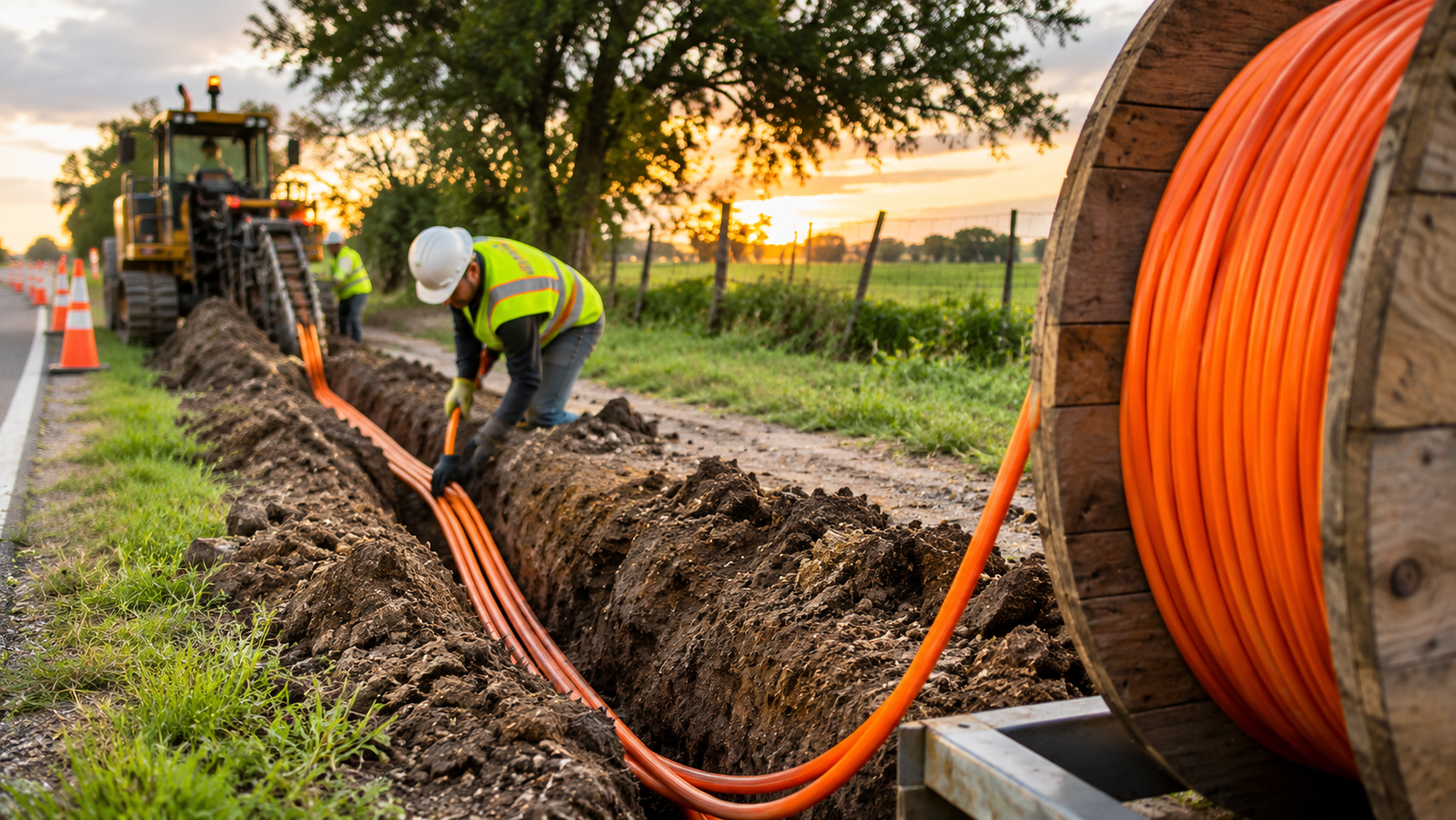
Nearby, Kyle describes AT&T’s installation process: crews locate existing utilities, notify affected homes and use directional boring to place conduit about 36 inches deep. Work takes place in utility easements, with contractors responsible for repairing disturbed landscaping.
Google Fiber, now known as GFiber, has its own construction footprint. Lakeway identifies an initial phase along Hurst Creek Road and Lohmans Crossing toward RR 620. The city posts work-area maps and warns of temporary lane closures. It does not provide neighborhood service dates.
For residents, the useful question is not simply whether fiber is coming to their city. It is whether their street is permitted, under construction or ready for a connection.
Regional networks reach beyond the largest metros
In the Panhandle, today’s service offerings have roots in earlier investment decisions. Vexus announced a privately funded $10 million Borger network in November 2023, with a planned reach of nearly 10,000 homes and businesses.
Now, T-Mobile Fiber markets service in Borger and asks residents to check their address. The original construction target and today’s retail listing show different steps in a network’s development; neither establishes that every property is connected.
South Texas offers another example of progress from digging to service. In February, Lyte Fiber announced its Pearsall network was live after an investment exceeding $3 million. The company described it as the city’s first residential fiber service, with an initial phase intended to reach nearly 2,800 locations across about 44 miles of fiber.
Meanwhile, a November 18 acquisition expanded Lyte’s footprint without representing an entirely new build. Lyte purchased MidSouth Fiber Internet from MidSouth Electric Cooperative, taking over an established network in Brazos, Grimes, Madison, Montgomery, Walker and Waller counties.
That network has an unexpected origin. The cooperative originally developed fiber to support its electric system, improve reliability and shorten outage recovery. Its communications subsidiary, established in 2019, turned that investment into an opportunity to serve homes and businesses.
Lyte projects that the combined business will pass more than 100,000 locations and serve about 25,000 subscribers by year-end 2026. The distinction is useful: a network can reach many more properties than the number of customers who have signed up.
Where federal broadband funding fits
Public money supports a separate part of the expansion. In its February review, Lyte distinguished private builds from preliminary federal broadband awards of $142 million, paired with nearly $40 million in private matching funds. The proposed reach was 9,670 unserved or underserved locations across seven counties. Those were award and coverage figures, not completed household connections.
Separately, the Infrastructure Investment and Jobs Act authorized the Broadband Equity, Access, and Deployment (BEAD) program. Texas’ current program page says federal officials approved a post-award change on October 15, 2026. The office lists $1.3 billion in BEAD funding and $187 million in state matching funds after that process. Those are award-program figures, not a count of finished fiber connections.
The program accepts qualifying technologies beyond fiber. Its next Texas supplemental eligibility challenge is scheduled to begin December 14, 2026. The state also seeks stakeholder feedback by 2 p.m. Central on December 11 and expects a location progress map in early 2027.
None of those statewide figures establishes that BEAD paid for Kinetic’s third-quarter additions, AT&T’s Buda work or GFiber’s Lakeway network. Each project needs its own funding record.
A buildout to follow street by street
For residents, the next step is specific: check the exact service address with each provider, then compare installation timing, upload and download speeds, equipment charges and the bill after any introductory offer. Renters should also ask whether their building is included. A nearby construction crew or citywide announcement alone cannot answer those questions.
For construction concerns, city project pages can identify the operator and the right contact for restoration issues. Buda’s map is especially useful because it separates permitted work from construction and completed areas.
Texas is gaining connections through many local efforts. The milestones worth watching are the ones that turn infrastructure into a usable service: a finished route, an activated network and a home or business able to order a connection.